
Conjoint Analysis: The best pricing research method for feature-rich products and services
Contents
- Why use conjoint analysis?
- How conjoint analysis works in practice
- Key use case: Pricing research
- Medtech pricing simulation
- Product and portfolio strategy using conjoint analysis
- Segmentation via conjoint analysis
- Types of conjoint analysis
- What conjoint analysis can’t do (and how to work around it)
- Getting conjoint analyses right: what to watch out for
- Deliverables from a conjoint study
- Conclusion
Why use conjoint analysis?
Conjoint analysis is a quantitative research method that reveals how people value different components or features of a product or service. It forces trade-offs, simulating real-world decisions far more effectively than traditional surveys. This makes it one of the most robust tools in the pricing and product development toolbox.
The core advantage of conjoint analysis lies in its ability to uncover implicit decision-making patterns. People often can’t articulate exactly why they choose one product over another, especially when multiple features, add-ons, and price points are in play. Conjoint analysis captures those trade-offs by observing actual choices, not just stated preferences.
It’s particularly valuable when launching new offers, adjusting price levels, exploring different pricing models, or making feature prioritization decisions, particularly in industries where offerings are technically complex. These include Medtech devices, SaaS platforms, industrial products, and durable consumer goods. While conjoint analysis is also widely used in FMCG, this article focuses on its use in feature-rich B2B products and services.
Conjoint analysis is particularly helpful in helping executives, product managers, and pricing strategists answer questions like:
- Product composition: What is the optimal combination of features or specifications?
- Portfolio optimization: Which product variants or tiers should be in the market?
- Pricing: What is the ideal price point, including how much more customers will pay for added features?
- Brand value: What premium does your brand command compared to competitors?
- Segmentation: How do preferences and price sensitivity vary across customer groups?
Let’s move on to how conjoint analysis works in practice.
How conjoint analysis works in practice
While this article focuses on B2B, let’s start with something most people can relate to: buying ketchup.
You walk into a supermarket and head to the ketchup aisle. You quickly discover there aren’t just two or three options. There may be 15 or more. Different brands, different sizes, some bottles are organic, some are sugar-free, some are upside down. And now you have to choose. If your go-to brand is available, the decision might be easy. But if you’re at an unfamiliar supermarket, with different brands and packaging options, you’re forced to evaluate what matters most to you. Price, size, brand, bottle type, ingredients may all play into your decision.
This is exactly the type of decision-making that conjoint analysis is designed to replicate. It mimics real market conditions by presenting respondents with different combinations of features, prices, and attributes, asking them to make choices rather than just stating preferences. The results give a much clearer view of what actually drives decisions, not just what people say they like.
In a typical conjoint analysis exercise, respondents are shown a series of product or service profiles. Each profile contains a specific combination of features and a price. The respondent is asked to pick the one they prefer from a set of alternatives.
Let’s look at an actual example of a conjoint analysis screen, in this case focused on laptops:
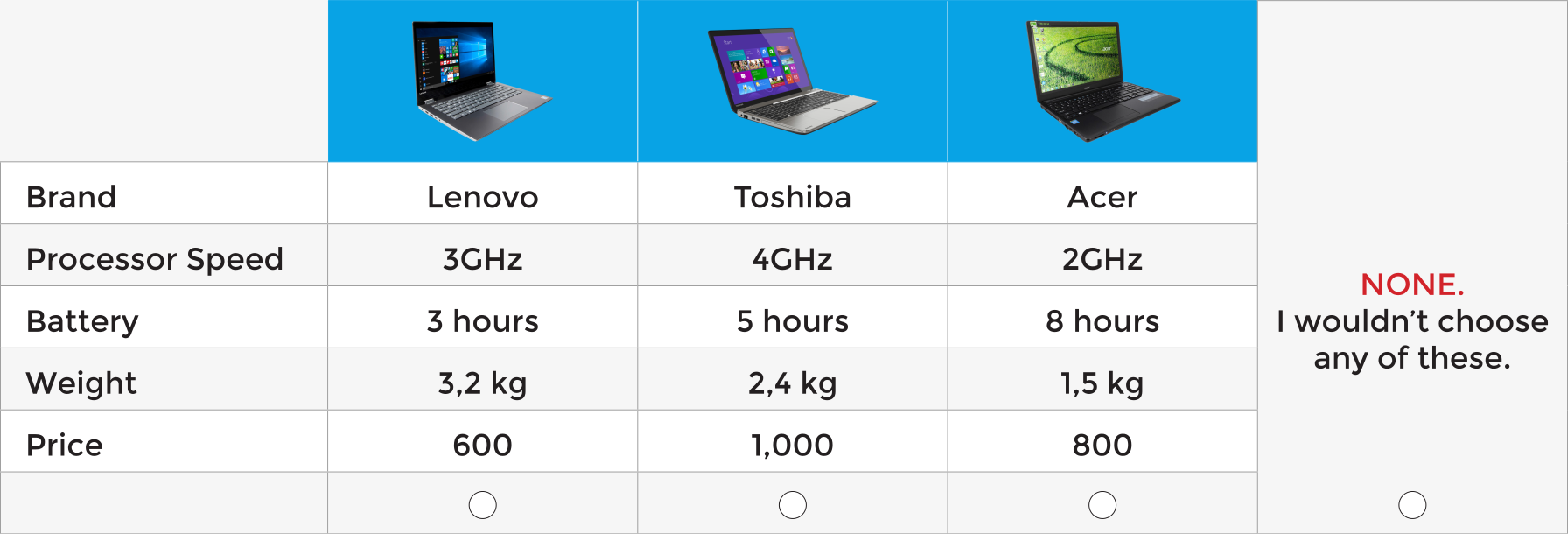
Each column represents a complete product profile with a combination of attributes; brand, processor speed, battery life, weight, and price. The respondent is asked to choose the option they would most likely buy. If none of the options are attractive, they can select “None” on the far right.
What matters here is that all the features are presented together. Respondents are not ranking battery life in isolation or stating how much they’d pay for 4GHz processors. Instead, they’re making holistic decisions based on realistic trade-offs just as they would in a store, or in a B2B procurement meeting.
In a full conjoint analysis, the respondent will go through multiple screens like this one, each with a new set of laptops made up of different feature and price combinations. The structure stays the same, but the individual attribute levels change. This repeated decision-making process allows the model to identify patterns and quantify how much each feature influences the overall choice.
From this data, we can conclude:
- Which features are most important in driving preference
- How customers trade off price against performance or convenience
- The relative value (or utility) of each feature
- How sensitive customers are to price changes
- What combination of features and price yields the highest market share
- How much more customers will pay for certain brands given the exact same feature specs
In more advanced conjoint analysis setups, you can also uncover distinct customer segments, each with their own preference profiles and price sensitivities.
Because respondents are forced to make trade-offs, conjoint analysis mimics real decision-making far better than surveys that ask for ratings or rankings or asking directly about pricing. This makes it particularly well-suited for pricing and product configuration decisions where nuance and complexity matter.
Key use case: Pricing research
One of the most valuable applications of conjoint analysis is pricing research, not just identifying what customers are willing to pay, but understanding why and how much their preferences change with price.
Most pricing methods offer a piece of the puzzle. For example:
- Van Westendorp pricing is quick and simple to run. It helps define an acceptable price range based on customer perception. This can be useful for early-stage pricing when you’re gauging whether your idea lands in the right ballpark, particularly for single-feature or commodity-like products.
- Gabor-Granger provides insights into price thresholds and volume expectations at different price points. It’s a solid method for simpler offerings, especially when you’re only adjusting price and not feature mix.
- Direct surveys can be useful when exploring qualitative price drivers, especially in B2B, where decision processes are complex and internal budgeting behavior matters.
- A/B testing gives real behavioral data, making it highly valuable for live products with enough traffic. It’s often used to fine-tune pricing pages or validate changes after launch.
However, each of these methods looks at price in isolation, or under artificial conditions.
Conjoint analysis, on the other hand, places pricing in the full context of the offer. It simulates realistic decisions by presenting customers with complete product profiles including prices, features, and trade-offs. This makes it particularly valuable for feature-rich B2B offerings, where price is only one of several factors influencing preference.
Thus, with conjoint analysis, you can quantify:
- Willingness to pay for specific features or bundles
- Price elasticity across different customer segments
- Optimal price points that maximize revenue, not just volume
- Perceptual price thresholds, where demand drops significantly
- The trade-offs customers are willing to make between price and functionality
Medtech pricing simulation
Below is an outcome from a conjoint analysis study in the Medtech sector. The analysis focused on identifying the optimal price point for a new product offering that combined AI functionality, speed, and value delivery based on customer preferences and market simulations.
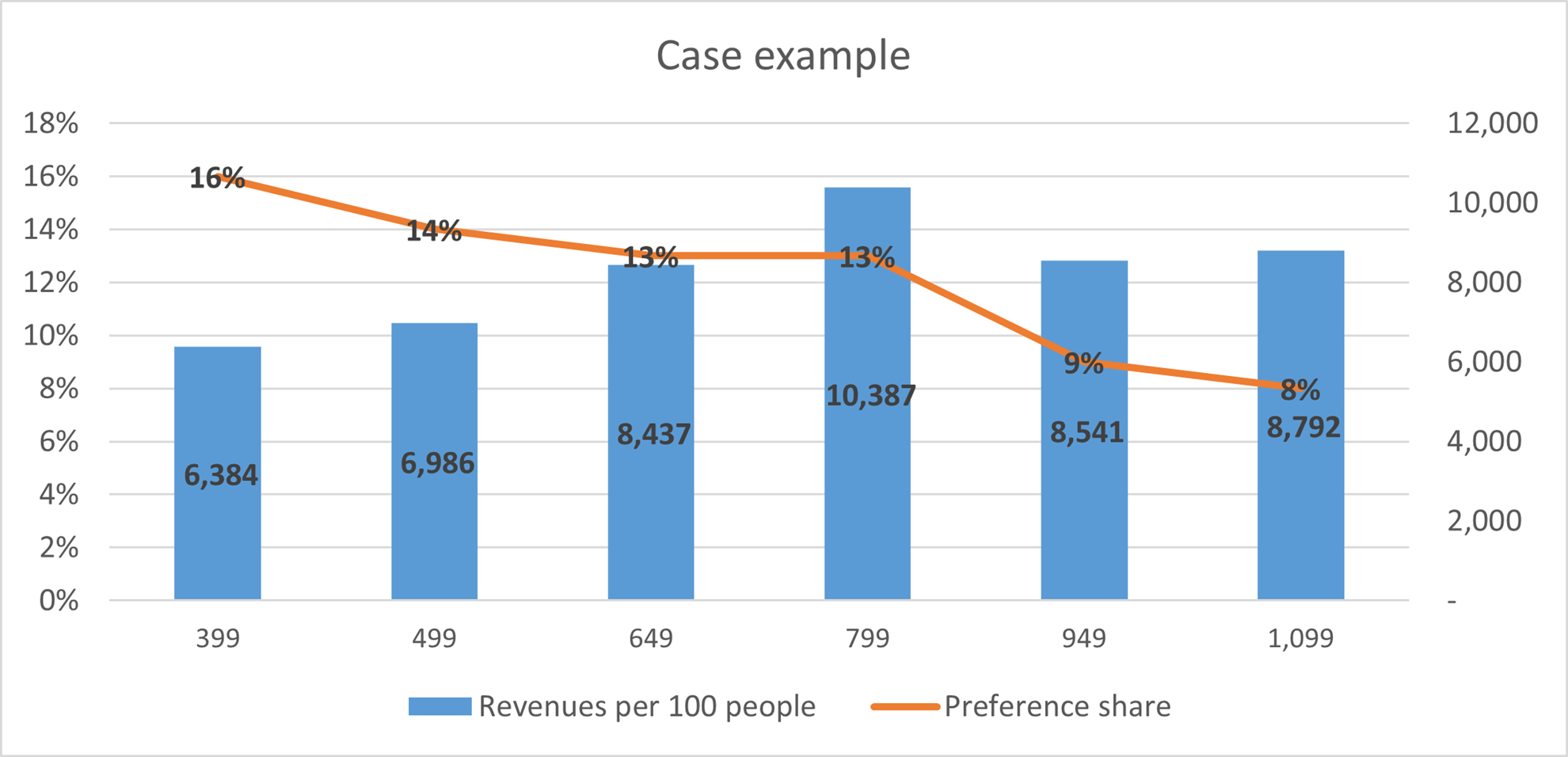
The orange line shows preference share at each price point, while the blue bars show revenue per 100 potential customers. As price increases from €399 to €799, revenue also increases, despite a slight decline in preference share. This is because the higher margin per unit compensates for the drop in volume.
However, once the price crosses €799, we observe a sharp decline in preference share dropping from 13% to 9%, then 8%. This signals a perceptual price barrier, beyond which customers perceive the product as too expensive relative to its value. At €799, the product hits a sweet spot: a price high enough to generate strong revenue, but low enough to maintain competitive preference.
In this case, conjoint analysis didn’t just deliver a price recommendation. It revealed a non-linear relationship between price and customer interest, something that would be invisible in simpler methods.
The study also allowed simulation of other combinations of features, packaging models, and competitor reactions, all within a market simulator, which we’ll return to later in this article.
Why this matters
Especially in B2B markets, where buyers often weigh dozens of factors before making a decision, understanding pricing in isolation isn’t enough. What matters is how price fits into the overall value proposition. Conjoint analysis is the only research method that delivers this level of insight reliably, before launch.
It allows you to answer:
- Should we launch at a premium or mid-market price?
- How sensitive is demand to small price increases?
- Is bundling high-value features more profitable than selling them as add-ons?
- Are we leaving money on the table by underpricing?
Conjoint analysis thus provides much deeper insights than traditional methods. As Brian Orme of Sawtooth Software notes, “conjoint analysis has gone on to become the gold standard approach for product feature and pricing optimization”.
Product and portfolio strategy using conjoint analysis
While pricing is often the headline application, conjoint analysis also plays a crucial role in product and portfolio strategy especially when you’re dealing with feature-rich configurable products, or multi-tiered offers.
Many companies make product decisions based on gut feeling, competitor benchmarking, or limited customer feedback. But these approaches rarely answer the most important questions with confidence:
- Which features are most important to customers?
- What trade-offs are buyers willing to make?
- How many product versions should we offer?
- Should we simplify, bundle, unbundle, or tier our offers?
- Will a new variant expand our market or cannibalize existing sales?
This is where conjoint analysis offers a more reliable path forward by giving you a market simulator that models real-world trade-offs at scale.
Take the example below:
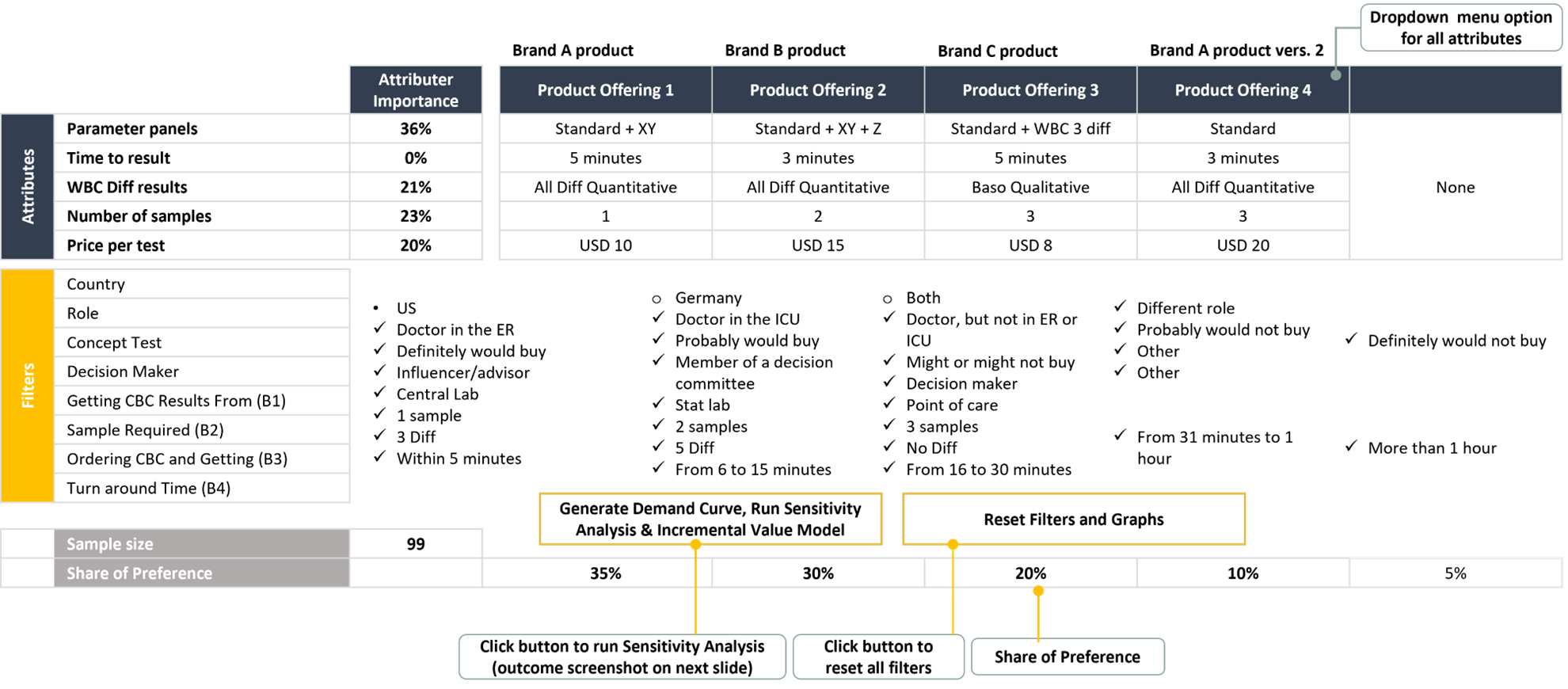
This market simulator allows decision-makers to configure and test different product offerings based on actual preference data derived from the conjoint analysis. Each column represents a potential product configuration. Attributes like parameter panels, speed, number of samples, and price can be adjusted directly while filters let you segment by region, industry, or role. As changes are made, the projected share of preference updates instantly.
This means you can answer questions like:
- What’s the most attractive combination of features for a mid-market segment?
- What happens to our market share if we remove a feature to reduce costs?
- Will a premium version increase our total revenue?
- What level of service or support actually drives purchase decisions?
By running multiple simulations, you can find the optimal number of offerings, avoid feature bloat, and ensure that each tier or bundle is actually addressing a distinct market need.
A recent industrial client used this tool to decide between two roadmap options: building a premium feature into all units or limiting it to an upgraded version. The simulator revealed that bundling it into the standard model increased overall preference only marginally. The added value was not compelling enough to shift the broader market’s choices. However, when the same feature was offered as part of a premium tier, it unlocked strong interest from a smaller but highly profitable segment that had previously felt underserved. These buyers were willing to pay significantly more for advanced functionality, and they didn’t expect it to be included in a base product. This insight helped justify the development cost while protecting margins and avoiding unnecessary giveaways to price-sensitive segments.
Beyond simulating different offers, the simulator can also generate sensitivity analyses like the one shown below:
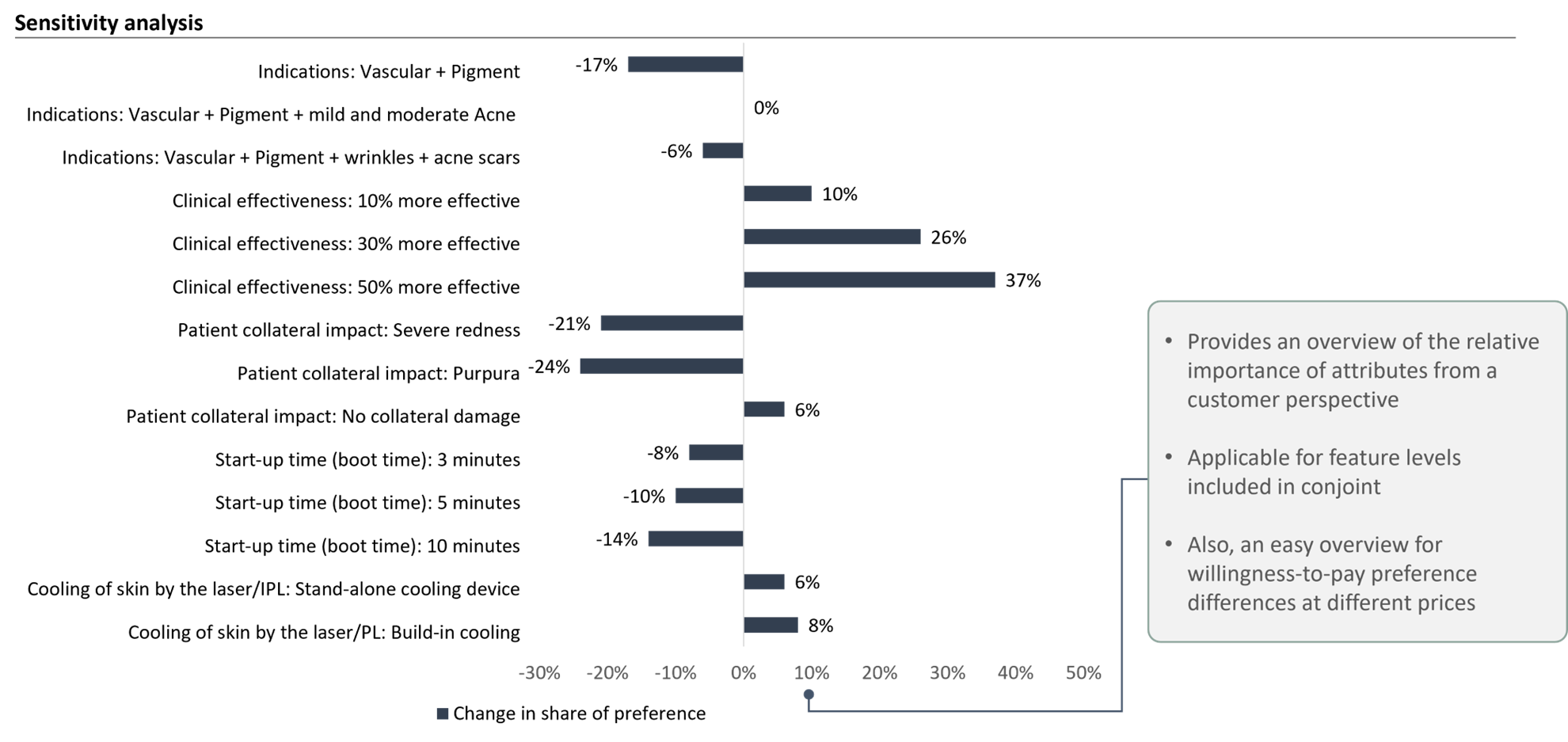
This chart shows the relative importance of each attribute and level from the customer’s point of view. In this example, features like response time, AI capability, and integration support are key value drivers, while price reductions beyond a certain threshold have diminishing returns.
With this kind of output, you can clearly see:
- Which features actually influence purchasing decisions
- How customers react to small vs. large changes in price or performance
- Where you should focus development, bundling, or sales effort
- What can be simplified or removed without hurting perceived value
For instance, if reducing support wait time from 12 to 4 hours drives a major increase in preference, that’s a strong case for operational investment. But if adding another layer of customization barely moves the needle, it may not justify the complexity or engineering cost.
SaaS case
A SaaS company recently used the market simulator to evaluate how to structure its pricing tiers for an enterprise collaboration platform. The team had been debating whether advanced analytics and single sign-on (SSO) should be included in the mid-tier plan or reserved for a premium version.
Using conjoint analysis, the market simulator revealed that including both features in the mid-tier would indeed increase preference among a broad segment of users, but not enough to offset the lost upsell opportunity. Most customers who were drawn to these features were also willing to pay for the premium tier when offered separately.
More importantly, when these features were bundled exclusively into a higher-priced Enterprise plan, they triggered a stronger shift in preference among IT buyers and procurement leads, particularly in regulated industries where security and reporting are non-negotiables. These users represented a smaller but highly valuable segment, with high willingness to pay and lower sensitivity to total seat cost.
The simulation showed that keeping these features gated behind the premium plan not only preserved the integrity of the mid-tier offer, it also expanded overall revenue potential by capturing more from the segment that valued advanced controls. This insight helped the company confidently adjust its tiering strategy, balancing customer acquisition with margin growth.
In short, conjoint-based market simulators allow you to replace guesswork with data-backed clarity. You’re no longer debating feature sets based on opinion – you’re testing combinations based on how real buyers actually choose.
Segmentation via conjoint analysis
Conjoint analysis naturally supports segmentation through filter-based views in the market simulator. When using platforms like Sawtooth Software, segmentation can go a step further with Latent Class analysis, which groups respondents based on how they actually make trade-offs in the study.
Instead of relying on traditional demographic or firmographic variables, Latent Class analysis identifies clusters of respondents with similar choice behavior. Each segment reflects a unique pattern of preferences, price sensitivity, and feature priorities. These segments are statistically derived, meaning they are based on how people behave, not just how they describe themselves.
The result is a set of discrete customer profiles that help answer questions like:
- Which segment is most responsive to premium features?
- Who is most price-sensitive, and where is the threshold?
- Are there opportunity spaces for a stripped-down or high-end version of our product?
These segments can then be explored directly in the market simulator. You can apply filters to see how each group responds to changes in product design, pricing, or bundling. For example, one segment might respond strongly to faster implementation time, while another cares more about support access and platform integrations.
Latent Class segmentation is especially useful when planning tiered offerings, regional strategies, or targeted marketing. It helps avoid a one-size-fits-all approach and enables a product strategy that reflects the actual structure of market demand.
Compared to more basic forms of post-survey segmentation, Latent Class models tend to deliver more predictive and stable insights. That’s why it is commonly used in advanced conjoint analysis studies, particularly for feature-rich B2B products where customer needs are diverse but hard to observe on the surface.
Types of conjoint analysis
There are several variations of conjoint analysis, each suited to different research situations depending on complexity, respondent fatigue, and the number of attributes to test. While Choice-Based Conjoint Analysis (CBC) remains the most widely used, other formats like Adaptive Conjoint Analysis (ACA) and Adaptive Choice-Based Conjoint Analysis (ACBC) provide valuable flexibility in specific cases.
Choice-Based Conjoint Analysis (CBC)
This is the most commonly used method and often the go-to standard in pricing and product optimization studies. In a CBC study, respondents are shown sets of product alternatives and asked to choose the one they prefer. Each product profile consists of a combination of attributes (e.g. price, features, brand), and each set typically includes three to five options plus a “none” alternative.
Best used when:
- The number of attributes is moderate (5 to 8)
- You need realistic, behavior-like data for market simulations
- You are comparing fully defined product concepts
- Simulating actual market behavior is the core objective
CBC works well in most commercial research settings and is particularly strong when feature sets are already known and clearly defined.
Adaptive Conjoint Analysis (ACA)
ACA was popular before CBC became dominant and is still occasionally used when the number of features is high and traditional choice tasks would be too burdensome. It works by tailoring questions to each respondent. After an initial ranking or rating task, the system adjusts subsequent questions based on prior answers to zero in on individual preferences.
Best used when:
- You have a large number of attributes (e.g. 10+), making choice sets too complex
- You want to minimize respondent fatigue or cognitive load
- You are testing individual-level preferences rather than aggregate choice behavior
However, ACA doesn’t include a competitive choice task, which limits its ability to simulate market outcomes. As such, it is less commonly used today for pricing and competitive analysis.
Adaptive Choice-Based Conjoint Analysis (ACBC)
ACBC combines the personalization of ACA with the realistic market simulation of CBC. It begins with a screening task, where respondents identify product configurations they find acceptable. Then it adapts the follow-up questions based on those choices. This results in more relevant, efficient, and respondent-friendly tasks.
Best used when:
- You are dealing with complex B2B products or highly configurable offers
- You want to test many features without overwhelming the respondent
- Respondent engagement and data richness are both priorities
- You need to simulate actual market choices and price sensitivity
ACBC tends to produce richer and more reliable data, especially when pricing and feature interactions are important. It also allows for better individual-level utility estimation, which improves segmentation and forecasting.
What conjoint analysis can’t do (and how to work around it)
While conjoint analysis is a powerful tool, like any method, it has limitations. Understanding where it falls short helps you design stronger studies and avoid misinterpreting results.
- It assumes rational trade-offs. Conjoint analysis is built on the idea that people make decisions by weighing pros and cons. It models structured, reasoned trade-offs. But in the real world, decisions are not always rational. Emotional factors like fear of missing out or internal group dynamics may influence purchasing behavior, especially in high-stakes or high-emotion environments. These influences tend to be underrepresented in a conjoint model (yet for most B2B purchases it’s not something to be concerned about). How to deal with it: Use qualitative research alongside your conjoint study. Interviews, focus groups, or behavioral observations can uncover emotional drivers and contextual realities that conjoint alone won’t capture. This doesn’t replace conjoint — it complements it and helps you interpret results more holistically.
- It’s not ideal for impulse or habitual purchases. Conjoint analysis works best when people actually engage in trade-off thinking. If the purchase is driven by routine or reflex (think chewing gum or buying printer paper), respondents are unlikely to process product configurations meaningfully. In those cases, conjoint won’t reflect real-world decision patterns. How to deal with it: Use conjoint for considered decisions where at least some evaluation takes place. This includes most B2B purchases, SaaS subscriptions, Medtech equipment, and complex consumer goods. For habitual or low-engagement categories, observational data, shopper research, or in-store experiments may be more appropriate.
- It may miss interaction effects. Conjoint models often assume that features operate independently – that the value of Feature A doesn’t depend on whether Feature B is present. But in practice, interactions are common. A buyer might value advanced analytics only if the product also includes real-time support. If your study doesn’t account for these interactions, you could overlook important value drivers. How to deal with it: Where interaction effects are likely, use more advanced conjoint designs (like ACBC) or flag interactions for special testing. Alternatively, include some combinations explicitly in your simulator to stress-test assumptions. Also note that advanced conjoint analysis software will be able to isolate for interaction effects.
Getting conjoint analyses right: what to watch out for
The difference between a study that delivers clear, actionable pricing and product guidance and one that produces noise often comes down to survey design. Even a solid method like conjoint analysis can fall flat if poorly executed. Below are the most critical areas to get right.
- Frame the choice situation realistically. It may sound obvious, but many studies fail here. If you are researching laptops, asking “Which one would you buy?” works fine. But what if you are designing for a Medtech or industrial context? A surgeon may have preferences, but their actual choice depends on the patient and the procedure. A technician may favor certain equipment, but local building codes or client budgets will influence the final decision. Your survey must reflect this reality. Otherwise, your data will not reflect actual behavior. Scenarios should mirror how choices are made in context, not just in theory.
- Ensure all features are clearly understood. Internal language can sneak into survey design without anyone noticing. Companies often use terms they believe are standard, but external respondents may interpret them very differently. This becomes even more important in Adaptive Choice-Based Conjoint Analysis, where respondents may see the same terms repeatedly and forget the definitions along the way. To avoid confusion, always pre-test the survey with actual users. Clarify technical or unfamiliar terms with hover-over explanations or brief tooltips during the task.
- Establish a price anchor. Price is only meaningful when people have something to compare it to. If there is no reference point, price levels may feel random, and your data on willingness to pay will suffer. This is especially important for new products or categories where respondents do not yet have mental benchmarks. Note however that the price anchor does not have to be specific prices. Where applicable we usually build the anchor around the value customers are getting. In Medtech, for instance, we use third-party research and citations that frame the potential economic value (health economics), but also list what we expect may be more intangible value. And we find again and again that customers are actually willing to pay more than expected.
- Don’t overload the number of features or levels. There is always pressure to test everything. But if you include too many attributes, you risk exhausting your respondents or prompting random clicking. On the other hand, if you test too few, your results will miss the real trade-offs that drive decision-making. Find the balance. Focus on the features that are genuinely up for debate or likely to influence outcomes. If needed, split the study into separate modules.
- Include realistic competitive alternatives. Your customers are not choosing only between your own options. They are comparing your offer to what competitors provide. If you omit relevant alternatives, your conjoint analysis is taking place in a vacuum. Make sure to include at least one or two realistic external references, even if they are simplified, so the choices reflect actual decision paths.
Deliverables from a conjoint study
To sum up, this is the actual deliverables you should expect from a conjoint analysis:
- Market simulator: an interactive tool that lets your team test different combinations of features and prices to predict market share.
- Feature importance scores: a rank-order of which features actually drive purchase decisions.
- Willingness-to-pay estimates: how much more (or less) people are willing to pay for a given change.
- Segmentation insights: latent class analysis reveals distinct buyer personas with unique preferences.
- Pricing strategy scenarios: recommendations for pricing tiers, bundling, and go-to-market adjustments based on simulated performance.
Conclusion
Conjoint analysis isn’t just another research tool. It’s a strategy enabler. For businesses with complex, feature-rich offerings, especially in Medtech, SaaS, durable goods, or industrial sectors, it delivers clarity around pricing, product design, and market segmentation. Don’t rely on guesswork, instincts, or isolated feedback – with conjoint, you simulate real decisions and act on reliable data.
Wondering how to apply conjoint analysis to your challenge? Get in touch and let’s explore it together. We’re fast, pragmatic, and known for understanding your business realities.