
Price Sensitivity Research Methods Explained: How to Measure and Apply It for Smarter Pricing Decisions
Contents
- Van Westendorp price sensitivity meter
- Gabor Granger pricing research method
- Price sensitivity through conjoint analysis
- Sales modeling to estimate price sensitivity
- Summary of core price sensitivity research methods
- Other methods to consider
- What is price sensitivity? A simple but crucial concept
- Conclusion
Most companies find themselves having daily or weekly discussions about price sensitivity. Whenever they prepare a proposal for a new or existing customer, they inevitably ask: What price will the customer accept? What price will be rejected?
In essence, this is a price sensitivity discussion – just at an individual level.
At the same time, companies frequently wonder whether they can raise prices without losing customers or attract more customers by lowering prices. This is price sensitivity on a broader, market level.
While it is often difficult to predict how individual customers will react to price changes, it is possible to gauge reactions at the market level using various market research techniques.
This article will guide you through the most commonly used market research methods for understanding price sensitivity, along with their pros and cons. Since many of our readers have told us that this is what interests them most, we’ll start there. However, if you’re less familiar with the concept of price sensitivity itself, feel free to jump ahead to the section where we explain the concept and the science behind it.
Van Westendorp price sensitivity meter
Since its development by Peter Van Westendorp in 1976, the Van Westendorp Price Sensitivity Meter has been widely used to assess price sensitivity – particularly for consumer goods and relatively simple B2B products.
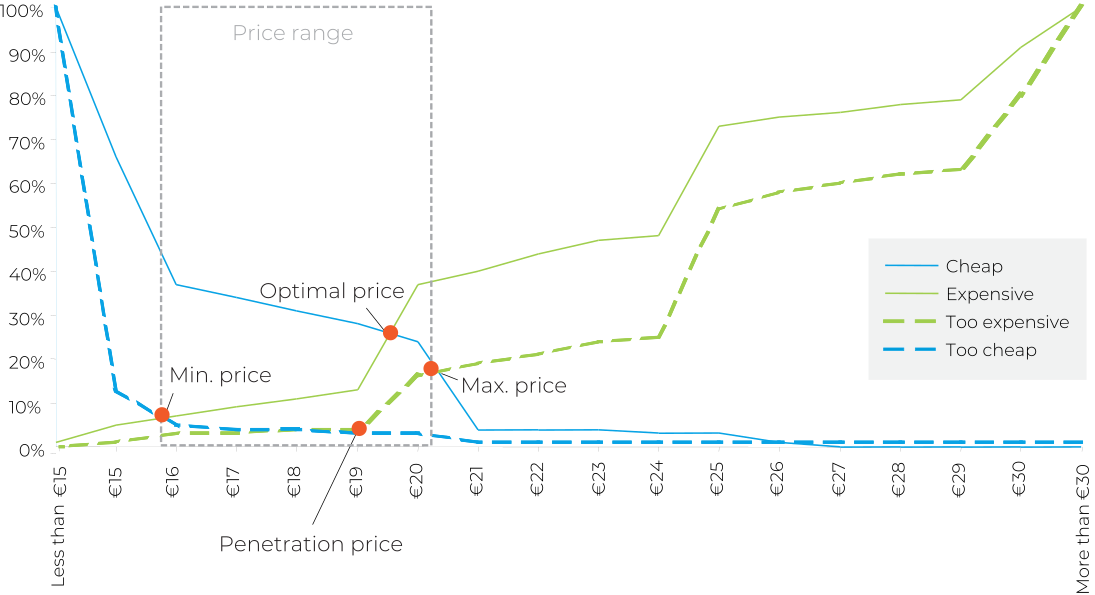
The Van Westendorp method is designed to reveal customers’ price sensitivity by identifying acceptable price ranges and perceived optimal prices through four straightforward questions:
- At what price would you consider this item to represent good value?
- At what price would you say this item is becoming expensive, but you would still consider buying it?
- At what price would you say this item is so expensive that you would no longer consider buying it?
- At what price would you say this item is so inexpensive that you would begin to question its quality?
Price graph: the optimal price for this segment is €19.50, the point perceived as expensive and cheap respectively by an equal share of customers. The acceptable price range runs from €17.50 to roughly €22.50.
Van Westendorp pricing sensitivity example
The strengths of the Van Westendorp method
The key strength of this method lies in its simplicity. It’s easy for companies to use and easy for respondents to understand. Without requiring complex modeling, the Van Westendorp approach provides a quick way to gather directional insights into price sensitivity and acceptable price thresholds.
The limitations of Van Westendorp in price sensitivity research
That said, this method has often been used more widely than it should – sometimes without fully considering its limitations when it comes to accurately measuring price sensitivity:
- Direct price questions and lowballing. The method relies on direct questioning about price, and people are known to understate their willingness to pay when asked directly. This can lead to artificially low estimates. Indirect pricing techniques can sometimes yield more accurate insights into true price sensitivity.
- Lack of buying intent measurement. Van Westendorp provides no indication of actual purchase intent. This can be addressed by screening respondents carefully or by asking a concept acceptance question beforehand. Only respondents who express a positive or neutral intent to buy should proceed to the pricing questions.
- No competitive context. The method asks respondents to assess pricing in isolation, without reference to competitors’ products or prices. In reality, buyers almost always compare options. While you can attempt to include competitor context, doing so within the Van Westendorp framework is difficult and often insufficient.
- No consideration for purchase frequency or volume. Van Westendorp doesn’t factor in how often people buy or the quantities they purchase. This might be acceptable for one-off purchases or low-frequency items, but for products with recurring purchases or significant volume variation, this is a serious limitation.
- Limited ability to handle product differentiation. The method struggles with complex or highly differentiated products – especially where multiple features, service levels, or embedded software create meaningful trade-offs for customers. For such offerings, conjoint analysis or other feature-based research techniques are typically more suitable for measuring price sensitivity.
When does Van Westendorp work best?
In our experience, the Van Westendorp method works best in the following situations:
- Fast-moving consumer goods (FMCG)
- New product launches where the product introduces an important new feature or innovation
The method is particularly helpful when customers already have a reference price for an existing product and you need to understand the marginal value they place on the new feature or improvement. In these cases, Van Westendorp can provide useful directional guidance on price sensitivity.
At Contribution, we offer pricing research packages that leverage the Van Westendorp technique while addressing many of its inherent limitations – enhancing the method with additional context, screening for buying intent, and, where appropriate, combining it with indirect pricing techniques to produce more reliable, actionable results. Read more about our pricing research services here.
Gabor Granger pricing research method: estimating price sensitivity with direct price-based questions
The Gabor Granger method is named after the economists André Gabor and Clive Granger, who developed it in the 1960s. It is a direct, survey-based pricing research method used to estimate optimal price points and assess price sensitivity by asking potential customers whether they would purchase a product at specific price levels.
How the Gabor Granger method measures price sensitivity
In a Gabor Granger analysis, respondents are first shown a product or service description and then asked a simple question: “Would you buy this product if it were priced at $X?”
Based on their response (yes or no), the price is adjusted either up or down for the next question. This adjustment can follow a fixed sequence or be made adaptively based on previous answers. The process is repeated a few times until it reveals the maximum price each respondent is willing to pay.
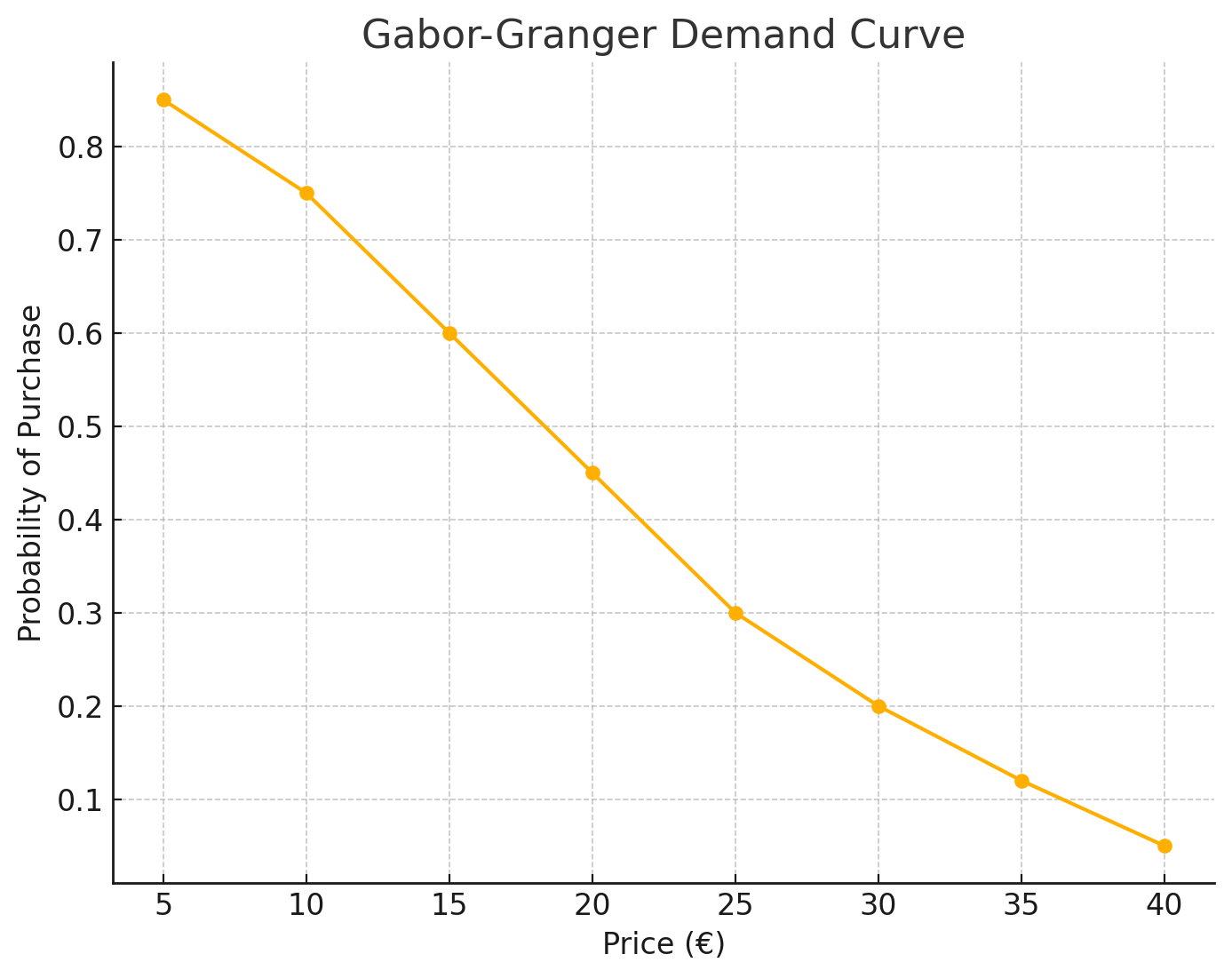
Each respondent therefore provides a series of buy/no-buy answers across multiple price points. When you aggregate these responses, you can build demand curves showing the percentage of people willing to purchase at each price level. From these curves, you can identify both the price sensitivity of your target market and the revenue-maximizing price.
Strengths and limitations of Gabor Granger in price sensitivity research
The Gabor Granger method shares many of the same strengths and limitations as the Van Westendorp Price Sensitivity Meter.
Strengths:
- It is simple to implement and easy for respondents to understand.
- It provides clear data on price sensitivity and demand across different price points.
- It allows for direct calculation of a revenue-maximizing price.
Limitations:
- Like other direct price methods, it is prone to hypothetical bias – people tend to understate their willingness to pay, which can skew the results and lead to underestimation of the true price ceiling.
- Responses can be anchored by the starting price shown in the first question. This starting-point bias can influence subsequent responses and distort the measurement of price sensitivity.
When does Gabor Granger work best for price sensitivity?
The Gabor Granger pricing method works best when:
- You need quick, directional insights into price sensitivity.
- The product or service is relatively simple and easy to explain in a research setting.
- You are looking to estimate optimal price points for new products or market entry.
It is especially useful for categories where there is already some understanding of the product value and where the buying decision is relatively straightforward.
Price sensitivity through conjoint analysis (trade-off research)
Conjoint analysis is a powerful market research method used to determine how people value different attributes of a product or service – including, crucially, price. Rather than asking directly about preferences or willingness to pay, conjoint analysis presents respondents with realistic choices between different combinations of features and prices, simulating actual decision-making situations.
How conjoint analysis measures price sensitivity
Conjoint analysis helps reveal three key insights that are highly valuable for understanding price sensitivity:
- The relative importance of each product attribute (including price) in driving customer choices
- The trade-offs customers are willing to make between different features and different prices
- The willingness to pay (WTP) for specific features as well as for overall product configurations
The real strength of conjoint analysis is that it generates a market simulator – a model that allows you to predict how different combinations of features and prices will perform in the market. In other words, you can simulate how changes in product design or pricing will affect customer preference shares and price sensitivity.
This works because, unlike other pricing research methods, conjoint analysis mimics real buying behavior. Respondents must choose between competing options, which means every selection automatically involves a de-selection – just like in real life. This trade-off mechanism is at the heart of why conjoint is so insightful for measuring price sensitivity.
If these were your only options, which would you choose?
Choose by one of the buttons below:

Why conjoint analysis is considered the gold standard for price sensitivity research
When set up correctly, conjoint analysis provides highly accurate and actionable data on how customers respond to different feature sets, prices, and combinations of both. This makes it one of the most robust tools available for measuring price sensitivity – and is precisely why most pricing consultancies recommend it for both pricing decisions and broader product strategy.
With conjoint analysis, you can:
- Identify optimal price points for different product versions
- Understand how much extra customers are willing to pay for additional features
- Simulate market share shifts in response to price changes
In short, conjoint allows you to move beyond guessing at price sensitivity and instead base decisions on hard evidence grounded in consumer choice behavior.
Limitations of conjoint analysis in price sensitivity research
Of course, like any method, conjoint analysis has its limitations, and it’s not always the right choice for every situation:
- It is complex to design and execute. A proper conjoint study requires specialized software and experienced pricing research consultants to set up and analyze the results correctly.
- It can be time-consuming and more costly compared to simpler pricing research methods.
- Some researchers highlight the risk of respondent fatigue, since evaluating multiple choice sets can feel repetitive. That said, skilled researchers know how to design the study to minimize this risk, using techniques like partial profiles or limiting task length.
When to use conjoint analysis for price sensitivity
Conjoint analysis is especially valuable when:
- Your product has multiple features or configuration options that influence purchasing decisions.
- You need to assess willingness to pay for new features or premium versions.
- You want to understand how your product will perform relative to competitors in the market.
- You are launching a new product or adjusting an existing portfolio and need data to support price positioning and product strategy.
While it may require more time and investment, the payoff is a high-confidence understanding of price sensitivity that can inform smarter, more profitable pricing decisions. Learn more about how we help businesses use conjoint analysis to measure price sensitivity and set better prices here.
Sales modeling to estimate price sensitivity
Sales modeling is a pricing research technique that uses historical sales data to uncover how sales volumes are affected by changes in price and other market variables such as seasonality, advertising, promotions, and competitors’ pricing.
When applied to pricing research, sales modeling helps estimate price elasticity and price sensitivity, quantifying how responsive customers are to price changes for a given product.
How sales modeling measures price sensitivity
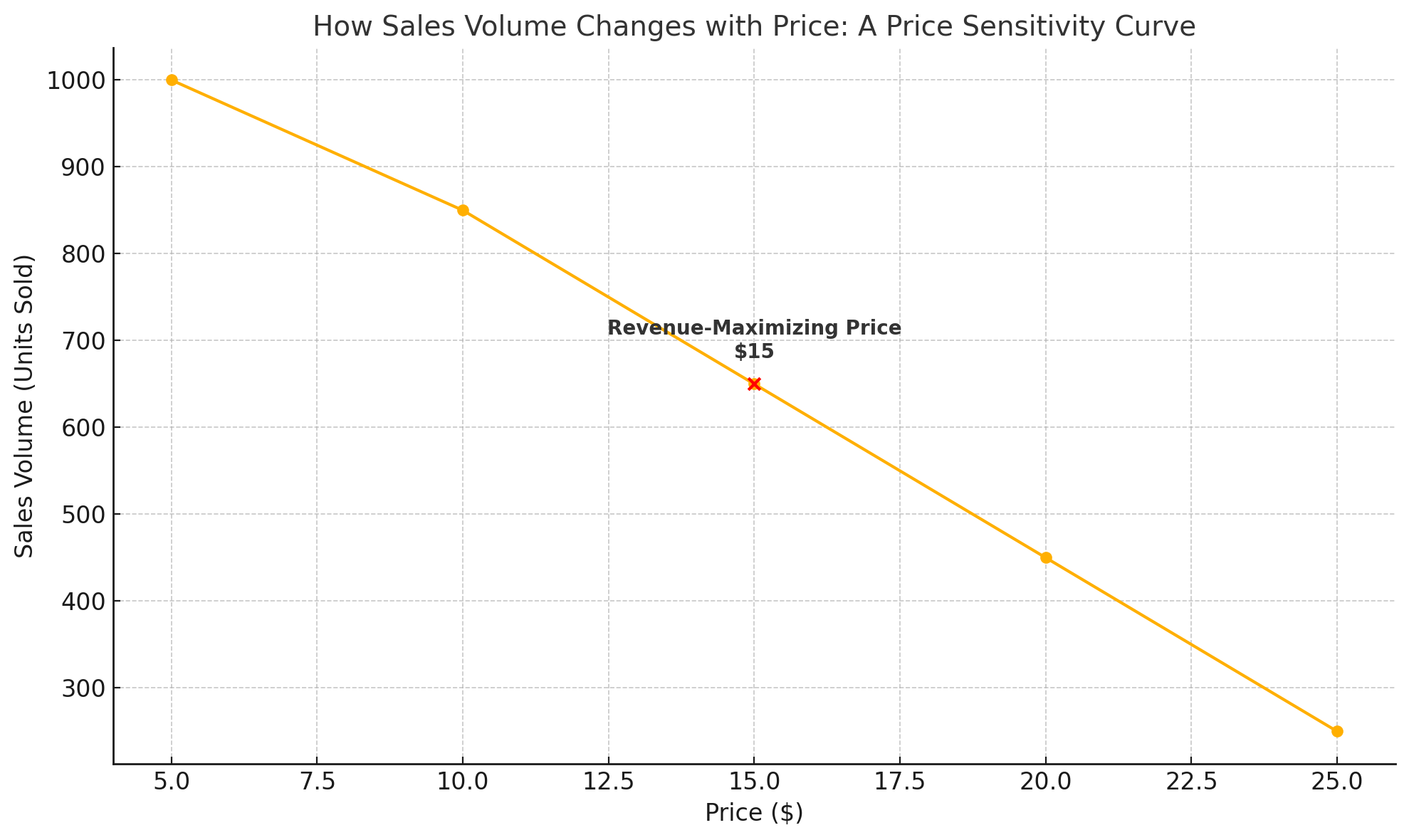
Sales modeling relies on statistical analysis of past sales data – typically from point-of-sale (POS) systems – to identify patterns between pricing and sales outcomes. By analyzing how sales have historically responded to price fluctuations (along with other factors), the model can estimate the degree of price sensitivity in the market.
With the rise of modern POS data management systems, sales modeling has become more accessible and widely used by businesses looking to refine their pricing strategies.
Price sensitivity curve based on sales data
Strengths and limitations of sales modeling for price sensitivity
Strengths:
- Sales modeling provides real-world evidence of how customers have behaved in the past in response to price changes.
- When you have a large, high-quality dataset, it can yield reliable estimates of price sensitivity and help inform price elasticity calculations.
Limitations:
- It can be challenging to isolate price effects from the many other variables that influence sales, such as promotions, seasonality, and competitive actions. This makes the analysis potentially complex, time-consuming, and costly.
- Historical data may not accurately predict future behavior in fast-changing or dynamic markets, where consumer preferences, technology, or competitive landscapes shift rapidly.
- Sales modeling struggles to assess price points beyond what has been tested historically. If you need to understand how a significantly higher or lower price might affect volume, sales modeling may not provide the answer without additional research.
When is sales modeling useful for understanding price sensitivity?
Sales modeling works best when:
- The product category is stable and operates in a mature market where past patterns are likely to hold.
- You have access to a large, clean dataset that reflects typical market conditions.
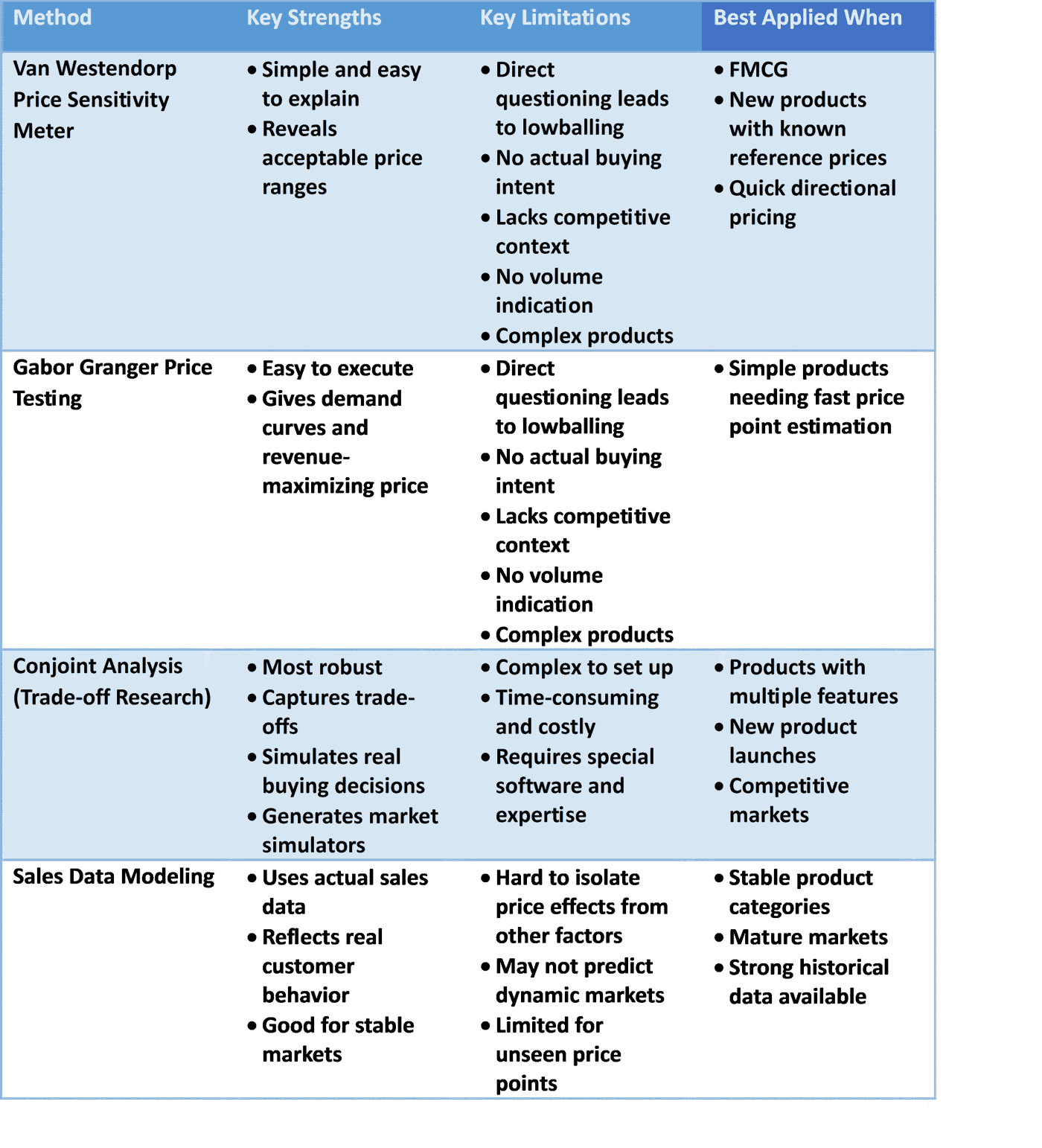
Summary of core price sensitivity research methods
Other methods to consider for measuring price sensitivity
In addition to the techniques we’ve covered – Van Westendorp, Gabor Granger, conjoint analysis, and sales data modeling – there are several other methods that can provide valuable insights into price sensitivity, depending on the product, market, and available data.
Brand-price trade-off (BPTO)
The Brand-Price Trade-Off method asks respondents to choose between different brand and price combinations. It is especially useful when both brand strength and price play significant roles in customer decisions. BPTO can help uncover the premium customers are willing to pay for strong brands and how price sensitivity shifts across competing offers.
Live price experiments (A/B testing)
In digital markets – such as e-commerce, SaaS, and subscription businesses – companies increasingly measure price sensitivity by running live price experiments. By exposing different customer segments to different price points, businesses can observe actual purchasing behavior rather than relying solely on survey data. This method yields highly actionable insights but requires careful ethical and commercial considerations.
Advanced econometric modeling
For organizations with large historical datasets, econometric modeling can reveal price sensitivity by controlling for multiple factors over time. Techniques such as time-series regression, ARIMA models, or machine learning can help identify price elasticity in complex environments. While these methods can be resource-intensive, they are invaluable in industries where precision is critical.
What is price sensitivity? A simple but crucial concept
At its core, price sensitivity refers to how responsive customers are to changes in price. In other words: how much does demand for a product or service change when the price changes?
Understanding price sensitivity is essential because it affects everything from pricing decisions to marketing strategy and even product development.
Elastic vs. inelastic demand: the basics
To make this idea practical, economists talk about two main types of demand:
- Elastic demand means that small price changes cause significant changes in sales volume. Example: airline tickets. If prices rise even slightly, many consumers will change travel dates, switch airlines, or cancel altogether.
- Inelastic demand means that even large price changes have little impact on how much people buy. Example: gasoline. Most people still need to drive, even if the price at the pump rises.
Similarly, luxury goods like high-end watches tend to face more elastic demand – people can easily delay or avoid buying them. On the other hand, everyday commodities like bread or salt tend to be less sensitive to price changes.
The science behind price sensitivity
To dig a little deeper, we need to introduce the idea of price elasticity of demand (PED) – the technical way economists measure price sensitivity.
Price elasticity of demand (PED): the key formula
The basic formula for PED is:
Price Elasticity of Demand = % Change in Quantity Demanded ÷ % Change in Price
- If PED is greater than 1, demand is elastic (high price sensitivity).
- If PED is less than 1, demand is inelastic (low price sensitivity).
For example:
- A 10% increase in price leads to a 20% drop in sales → PED = 2 (elastic)
- A 10% increase in price leads to a 2% drop in sales → PED = 0.2 (inelastic)
Factors that influence price sensitivity
Several factors explain why some products have higher price sensitivity than others:
- Availability of substitutes. The more alternatives exist, the higher the price sensitivity. If one brand of cereal raises prices, customers can easily switch.
- Necessity vs. luxury. Essentials like medication tend to have low price sensitivity, while non-essentials like designer handbags have higher sensitivity.
- Time horizon. Over time, customers may find alternatives or adjust behavior, making demand more elastic in the long run.
- Brand loyalty. Strong brands reduce price sensitivity. Loyal customers are often willing to pay more (Apple is a classic example).
Conclusion: measuring price sensitivity is not a one-timer
Understanding and measuring price sensitivity is not a one-time task. Markets change, competitors evolve, consumer expectations shift, and economic conditions fluctuate. What works today may not work tomorrow.
That’s why the most successful businesses treat pricing not as a fixed decision but as a dynamic, data-driven process. By regularly measuring price sensitivity – whether through market research methods like Van Westendorp, Gabor Granger, conjoint analysis, or sales data modeling – companies can make smarter decisions that drive both profitability and customer loyalty.
The key is to move away from gut-feel or cost-based pricing and towards continuous testing of pricing strategies, using real customer data to inform decisions, balancing value creation with competitive positioning, and understanding the psychological dimensions of price, not just the economic ones. Doing this not only captures value for your business but also resonates with your customers.