
Van Westendorp Price Sensitivity Meter: Understanding Its role in modern B2B pricing
Contents
- IntroductionWhat is the Van Westendorp model, who developed it, and when is it relevant in B2B pricing?
- What Is the Van Westendorp price model?A look at the four core questions, what they measure, and how to interpret the results.
- Limitations and criticism of the Van Westendorp modelA comprehensive overview of known issues, from lack of behavior insight to poor fit for complex products.
- The question of the price corridorWhy the concept of a pricing range is not always useful in operational decision-making.
- No link between price and volumeThe risk of missing demand impact when relying solely on perception-based responses.
- How to deal with the limitations
- Addressing key limitations through better questionnaire designPractical adjustments that make the model more useful without changing its structure.
- When a different methodology is the better answerWhen to move beyond Van Westendorp and which methods to consider instead.
- Summary tables for practical referenceTwo visual overviews covering Van Westendorp limitations and alternative pricing methods.
- FAQ: Applying the Van Westendorp model in B2B pricingStraightforward answers to the most common questions and misconceptions.
- Ready to use Van Westendorp more effectively?A final invitation to connect and discuss your pricing strategy.
Introduction to Van Westendorp
In B2B markets, pricing is rarely a simple matter of supply and demand. Products are often feature-rich, buying decisions involve multiple stakeholders, and perceived value can be shaped by far more than just product specifications. Against this backdrop, the Van Westendorp approach offers a structured, but limited, way to assess how customers perceive price fairness.
Originally introduced in the 1970s by Dutch economist Peter van Westendorp, the Van Westendorp price sensitivity meter was designed to explore customers’ intuitive sense of what is too cheap, too expensive, and acceptable. Van Westendorp’s objective was to create a method that could help companies establish a price corridor based on perceived value, particularly for products with limited pricing history or undefined market norms.
Compared to more advanced methods such as conjoint analysis or discrete choice modeling—which simulate actual market decisions, the Van Westendorp price model is simpler and faster to execute.
However, this simplicity is also its limitation. The method does not take into account competitive context, actual purchase behavior, or the influence of product attributes. In markets with heavy product differentiation; such as software, industrial solutions, or complex service bundles, the absence of feature-level trade-offs makes the method less suitable as a standalone solution.
In general, Van Westendorp is best applied in early-stage pricing for relatively simple or unfamiliar offerings, where customer intuition around pricing has not yet been anchored by strong competition or detailed comparisons. It works less well in mature markets, or when customers are selecting between bundles of features where price is just one of several decision criteria.
What is the Van Westendorp price model?
The Van Westendorp price model is built around four structured questions designed to uncover the psychological boundaries customers associate with price. Each question targets a specific part of the perceived value spectrum:
- Too Cheap – At what price would the product be so inexpensive that you would question its quality? This identifies the lower limit of acceptable pricing. If a product is priced below this point, customers may assume it’s unreliable, low-grade, or otherwise not credible.
- Bargain – At what price would you consider the product to be a good deal? This helps pinpoint where the product offers maximum perceived value without triggering quality concerns. It’s often where the perceived benefit-to-cost ratio peaks.
- Getting Expensive – At what price does the product begin to feel expensive, but still within consideration? This defines the upper limit of psychological tolerance, signaling where customers start weighing trade-offs, but haven’t ruled the product out entirely.
- Too Expensive – At what price would the product become too expensive to consider? This is the hard ceiling. Prices above this threshold are typically seen as unjustified, regardless of product quality or brand reputation.
The Van Westendorp price sensitivity meter takes the responses to these questions and plots them as cumulative frequency curves. Where these curves intersect, several useful price points can be identified:
- Point of Marginal Cheapness: the intersection of the ‘Too Cheap’ and ‘Getting Expensive’ curves.
- Indifference Price Point: where the ‘Too Expensive’ and ‘Too Cheap’ lines cross.
- Point of Marginal Expensiveness: where the ‘Too Expensive’ and ‘Bargain’ lines intersect.
- Optimal Price Point (OPP): often considered the price where an equal number of respondents feel the product is too cheap and too expensive.
Example: Imagine a software tool where the plotted responses reveal that:
- 15% of respondents say €16 is too cheap,
- 50% say €25 is too expensive,
- 30% feel €19.5 is a good deal (cheap),
- and 40% start finding it expensive at €20.
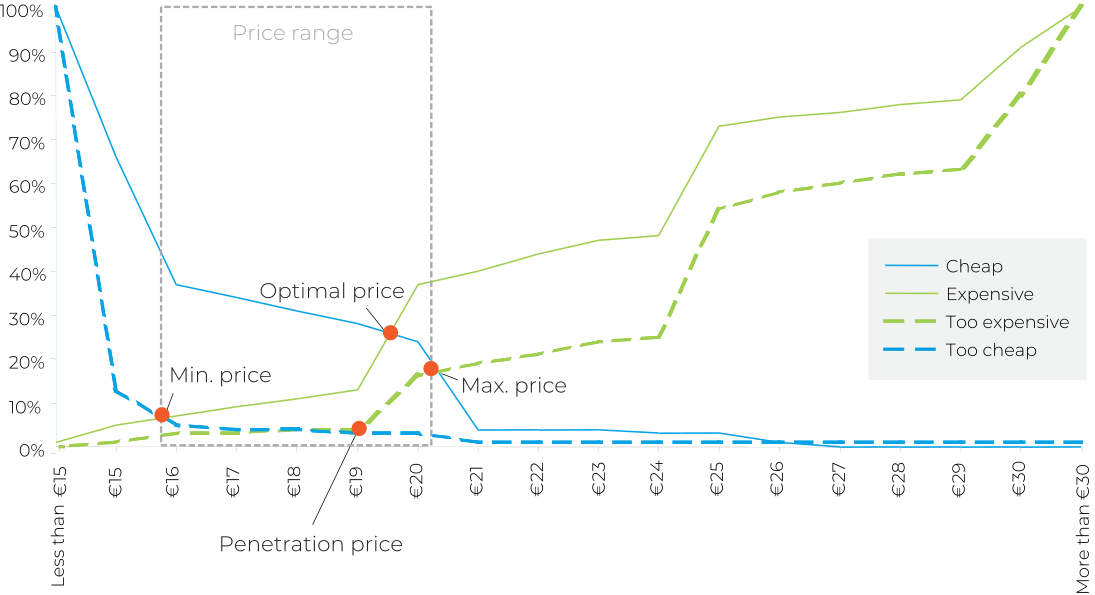
From such a graph, you might determine that the optimal price range lies between €16 and €20, with an optimal price at €19.5. You also see that although the max. price is indicated slightly above €20, at the same time the €20 price point marks a sharp decline in the Cheap perception, indicating a psychological price threshold at this point. This provides clear, visual guidance on where your price is most likely to be accepted without harming perceived value.
Limitations and criticism of the Van Westendorp price model
While the Van Westendorp approach has enjoyed wide adoption in pricing research, it is not without significant flaws. These limitations are important to understand, particularly in a B2B context where pricing decisions often depend on nuanced factors. Below is a comprehensive look at the most commonly cited issues, along with explanations of why they matter in practice.
No insight into actual buying behavior
Perhaps the most fundamental limitation of the Van Westendorp price model is that it does not measure whether the customer would actually purchase the product at the stated prices. The methodology asks respondents to indicate price thresholds that feel too low or too high, but these are purely perceptual judgments. They are not tied to real purchase intent or behavioral outcomes such as conversion rates or sales volumes.
This disconnect can be especially problematic in B2B environments, where purchasing is rarely impulsive and often influenced by long-term value, procurement policy, and stakeholder alignment. A price might fall within the acceptable range, yet still fail to trigger a purchase decision because other decision drivers carry more weight.
Ignores competitive context
Another critical shortcoming is the absence of competitor comparison. The Van Westendorp price sensitivity meter assumes that customers evaluate price in isolation. But in most B2B markets, buyers do not consider pricing in a vacuum. They assess what they get relative to alternatives already available in the market.
Without any reference to competing offers, the method cannot account for pricing strategies shaped by differentiation, bundling, loyalty advantages, or total cost of ownership. This makes the insights incomplete if used as the sole basis for strategic pricing.
Vulnerable to low estimates and conservative bias
Because respondents are asked directly about price expectations, there is a well-documented tendency for answers to skew low. Some will intentionally understate what they are willing to pay, especially if they believe the information could influence future pricing. Others simply default to safe or cautious estimates.
In B2B interviews, this effect can be amplified by procurement roles that are trained to anchor low, or by pricing norms where negotiations are expected. As a result, relying too heavily on raw Van Westendorp outputs risks undervaluing the product and setting prices that leave margin on the table.
Poor fit for feature-rich or modular offerings
Many B2B solutions are defined by their complexity. Whether it’s a software suite, a technical service package, or a customized industrial product, the customer is often buying a combination of functions, benefits, and support. In such cases, willingness to pay depends on how those specific features are understood and prioritized.
The Van Westendorp price model does not capture any of this complexity. It treats the product as a monolithic offer and does not allow for trade-offs between features and price. This makes it poorly suited for pricing products where the value proposition is multi-layered or varies significantly across segments.
Inconsistent performance in commoditized categories
Ironically, the method also underperforms in the opposite scenario—highly commoditized products. When customers are used to well-defined market pricing and minimal differentiation, their responses often cluster around expected norms, regardless of the actual product presented. The graphs generated from such data tend to look similar across different studies, making it harder to detect meaningful insights or differences.
Assumes all respondents can articulate value rationally
Another subtle but important limitation is the assumption that customers can reliably identify and articulate their pricing thresholds. In reality, many struggle to judge what a product should cost, particularly when the benefits are intangible, indirect, or long-term. This is especially true in emerging categories, where value may only become clear after implementation.
The Question of the price corridor
One of the more distinctive features of the Van Westendorp price model is its output: not a single price point, but a price corridor. This corridor represents the range between what respondents consider too cheap to be credible and too expensive to consider. It is often interpreted as a zone of acceptable pricing, within which a product is unlikely to face rejection based purely on price perception.
While this may seem useful at first glance, it also raises a practical concern. In reality, companies do not sell products within a corridor. They set a single price, or perhaps a tiered structure across segments or configurations. The idea of operating within a range is appealing from a research perspective but often lacks direct operational relevance.
This disconnect has led to growing skepticism about the usefulness of the corridor concept. Strategic pricing decisions require clarity. They demand a number that can be justified internally, supported by business economics, and communicated externally. A range, by contrast, offers directional guidance but does not resolve the core pricing question: what should we charge?
In B2B markets especially, where pricing must reflect cost structures, commercial goals, and often complex value propositions, relying on a corridor can feel imprecise. It may help avoid extreme pricing mistakes, but it does not tell the business where the price should land within that range or whether that price aligns with broader strategic intent.
For this reason, while the Van Westendorp price sensitivity meter can inform pricing discussions, the concept of a price corridor should be viewed critically.
No link between price and volume
Another major limitation of the Van Westendorp price model is its inability to predict how price changes will impact sales volume. While the method offers insight into how customers perceive price fairness, it does not indicate how many would actually buy at those price points—or how demand would shift if the price moved higher or lower.
This is a serious shortfall in any pricing research aiming to support business decisions. Without volume data, companies cannot model revenue, forecast margins, or evaluate trade-offs between price and market penetration. A price that sits comfortably within the acceptable range may still underperform if it does not generate sufficient demand. Conversely, a higher price outside the preferred range might yield better commercial outcomes if volume is only modestly affected.
Other pricing research methods, not least conjoint analysis, are specifically designed to estimate this relationship between price and purchase likelihood. These models simulate demand curves and can quantify price elasticity, allowing for more financially grounded decisions. In contrast, the Van Westendorp price sensitivity meter remains anchored in perception, not behavior.
For this reason, it should be used cautiously—and ideally not in isolation—when pricing decisions depend on volume-sensitive outcomes.
How to deal with the limitations
The Van Westendorp model has clear blind spots. That does not mean it should be dismissed, but rather that it must be applied carefully and supported by complementary techniques or study design improvements. Below are practical ways to address some of the more critical limitations, beginning with the most fundamental.
Bridging the gap between price perception and buying intent
One of the most important enhancements to the original Van Westendorp framework was proposed in the early 1990s by researchers Newton, Miller, and Smith. Their addition, often referred to as the Purchase Intent Extension, introduced a simple but effective way to add behavioral weight to the otherwise perceptual model.
The approach involves asking respondents a follow-up question at two of their own stated price points; the one they consider a bargain (but still credible), and the one they feel is starting to become expensive, but still acceptable. For each of these prices, the respondent is asked how likely they would be to purchase the product. Typically, this is done using a five-point intent scale, ranging from “definitely would buy” to “definitely would not buy.”
By anchoring perceived price acceptability to an explicit likelihood of purchase, the data becomes far more actionable. It starts to reflect not just how customers think about price, but how they might behave in a real decision.
Of course, it is well understood that self-reported buying intent tends to overestimate actual behavior. To correct for this, many researchers apply adjustment factors based on historical calibration. For example, only a percentage of those who say they would “definitely” or “probably” buy may actually follow through in a real buying scenario. These correction factors help bring stated intent closer to commercial reality.
While this extension does not fully turn Van Westendorp into a demand model, it brings it closer to what pricing practitioners need: insight that not only describes where a product is acceptable, but where customers are most likely to act.
Addressing key limitations through better questionnaire design
The Van Westendorp model has clear blind spots. That does not mean it should be dismissed, but rather that it must be applied carefully and supported by complementary techniques or study design improvements. Below are practical ways to address some of the more critical limitations, beginning with the most fundamental.
Bridging the gap between price perception and buying intent
One of the most important enhancements to the original Van Westendorp framework was proposed in the early 1990s by researchers Newton, Miller, and Smith. Their addition, often referred to as the Purchase Intent Extension, introduced a simple but effective way to add behavioral weight to the otherwise perceptual model.
The approach involves asking respondents a follow-up question at two of their own stated price points; the one they consider a bargain (but still credible), and the one they feel is starting to become expensive, but still acceptable. For each of these prices, the respondent is asked how likely they would be to purchase the product. Typically, this is done using a five-point intent scale, ranging from “definitely would buy” to “definitely would not buy.”
By anchoring perceived price acceptability to an explicit likelihood of purchase, the data becomes far more actionable. It starts to reflect not just how customers think about price, but how they might behave in a real decision.
Of course, it is well understood that self-reported buying intent tends to overestimate actual behavior. To correct for this, many researchers apply adjustment factors based on historical calibration. For example, only a percentage of those who say they would “definitely” or “probably” buy may actually follow through in a real buying scenario. These correction factors help bring stated intent closer to commercial reality.
While this extension does not fully turn Van Westendorp into a demand model, it brings it closer to what pricing practitioners need: insight that not only describes where a product is acceptable, but where customers are most likely to act.
When a different methodology Is the better answer
While several of Van Westendorp’s limitations can be softened with smarter questionnaire design, others reflect deeper structural gaps in the model. In these cases, trying to force-fit a fix only creates confusion or false confidence. The better approach is to use a different pricing method entirely, one that is built to handle the complexity or precision required.
Estimating demand and revenue outcomes
Van Westendorp is not designed to measure how price affects purchase volume. For B2B pricing decisions where volume sensitivity is central, such as forecasting revenue, assessing breakeven points, or evaluating price elasticity, a more suitable method is needed. Gabor-Granger is one option, offering a simple survey-based model that maps willingness to buy across a structured range of prices. For more complex offers, conjoint analysis or discrete choice modeling allow companies to simulate customer decisions and predict volume at different pricing levels. These models connect price to behavior, not just perception.
Capturing value in feature-rich or modular products
B2B offerings are often defined by their configurations. Whether it’s software tiers, service bundles, or physical components, pricing needs to reflect how buyers evaluate combinations of features. Van Westendorp cannot handle these trade-offs. Conjoint analysis remains the most recognized solution here, as it forces respondents to choose between packages that vary in both content and price. The resulting data can be used to model which features drive value and how much customers are willing to pay for them. For more focused insight on feature importance without full pricing simulation, MaxDiff analysis is another proven tool.
Moving beyond abstract perceptions
Another limitation of the Van Westendorp price model is its reliance on respondents being able to articulate what price feels fair or excessive—without any situational context. For some markets, especially those involving high stakes or unfamiliar categories, this is unrealistic. In such cases, qualitative methods like in-depth interviews may be a better starting point. These conversations help uncover how buyers think about value, how decisions are made internally, and what role price actually plays in the process. This qualitative insight can then inform the design of a more structured study using appropriate quantitative methods.
Linking pricing to strategy and margin
Finally, Van Westendorp provides no guidance on whether a given price is commercially viable. It does not consider cost structure, positioning strategy, or financial goals. This makes it unsuitable as a standalone method for setting price. When price setting needs to reflect both customer willingness to pay and internal constraints, the research must be combined with financial modeling and value-based pricing tools. Economic value estimation or customer value modeling are often used in B2B settings to bridge this gap between perception and profitability.
In short, while Van Westendorp can offer directional input, some questions are simply better answered by more advanced or targeted pricing methodologies. Recognizing when to make that shift is part of building a disciplined and effective pricing strategy.
Summary tables for practical reference
To support more effective decision-making, the following two tables provide a structured overview of how to deal with the Van Westendorp model’s limitations and how it compares with other commonly used pricing research methodologies. These summaries are designed to serve as a reference point for teams evaluating when and how to apply different approaches.
Table 1: Limitations of the Van Westendorp model and how to address them
| Limitation | Can be addressed within VW? | Suggested solution |
|---|---|---|
| No insight into actual buying behavior | Yes | Use the Newton-Miller-Smith Purchase Intent Extension with calibrated intent scales |
| No link between price and volume | No | Use Gabor-Granger or Conjoint Analysis to estimate demand and revenue impact |
| Ignores competitive context | Yes | Add follow-up questions comparing prices to known alternatives or market norms |
| Vulnerable to lowballing / conservative responses | Yes | Use value framing and ask for justification behind too-high or too-low price responses |
| Poor fit for feature-rich or modular products | Partially | Include ranked feature importance questions or run separate surveys per configuration |
| Price corridor lacks operational clarity | No | Overlay cost and strategic pricing targets to identify actionable price points |
| Assumes rational and articulate respondents | No | Use in-depth interviews or qualitative pre-work to validate price perception data |
Table 2: Overview of common pricing research methods
| Method | Strengths | Limitations | Best used when |
|---|---|---|---|
| Van Westendorp | Simple, quick to deploy, defines acceptable price ranges | No volume insight, ignores competition, abstract responses | Early-stage pricing for new or unanchored products |
| Gabor-Granger | Directly links price to purchase intent, estimates demand curve | Still uses hypothetical responses, limited feature insights | Assessing price elasticity and revenue potential |
| Conjoint Analysis | Simulates real-world trade-offs, supports feature-price modeling | Complex to design and analyze, higher cost | Pricing feature-rich or competitive products |
| Discrete Choice Modeling | Advanced simulation of market choices, predicts market share shifts | Requires deep statistical expertise, data-intensive | High-stakes pricing in competitive and segmented markets |
| In-Depth Interviews | Rich qualitative insights, uncover underlying value drivers | Small sample, non-generalizable, time intensive | Exploring complex B2B buying decisions or testing early-stage hypotheses |
| Economic Value Estimation | Quantifies value based on customer economics, aligns with strategy | Requires strong data and internal cost transparency | Value-based pricing in B2B with measurable outcomes |
FAQ: Applying the Van Westendorp model in B2B pricing
Is Van Westendorp suitable for setting a final price?
Not on its own. It helps identify an acceptable range, but the final price should also reflect margin targets, strategy, and competitive position.
Can Van Westendorp predict how many customers will actually buy?
No. It captures price perception, not purchase behavior. To estimate demand or revenue, you need methods like Gabor-Granger or conjoint analysis.
How can I make Van Westendorp more actionable?
Use the Newton-Miller-Smith Purchase Intent Extension. Ask respondents how likely they are to buy at their own acceptable price points.
What if my product is complex or has multiple configurations?
Van Westendorp struggles with feature-rich products. Consider using conjoint analysis to capture trade-offs between features and pricing.
Does the model consider competitors?
Not by default. To improve realism, add follow-up questions that reference alternative offerings or typical market prices.
Is the price corridor output enough to guide pricing?
It’s a helpful diagnostic, but not a decision. Use it as input—then layer in financial, strategic, and market-based considerations.
Can I rely on responses to be accurate?
Some respondents tend to understate what they’d pay. Framing the value first and asking for reasoning behind their answers can help correct for this.
Ready to use Van Westendorp more effectively?
If you’re considering Van Westendorp for an upcoming pricing project, or rethinking how to structure your existing pricing research, we’re happy to help. Whether it’s refining your questionnaire design or selecting the right mix of methodologies, we can ensure your insights lead to clear and commercially grounded decisions.